The Giving Paradox: What Wealthy Nations Get Wrong About Generosity
Jul 14, 2026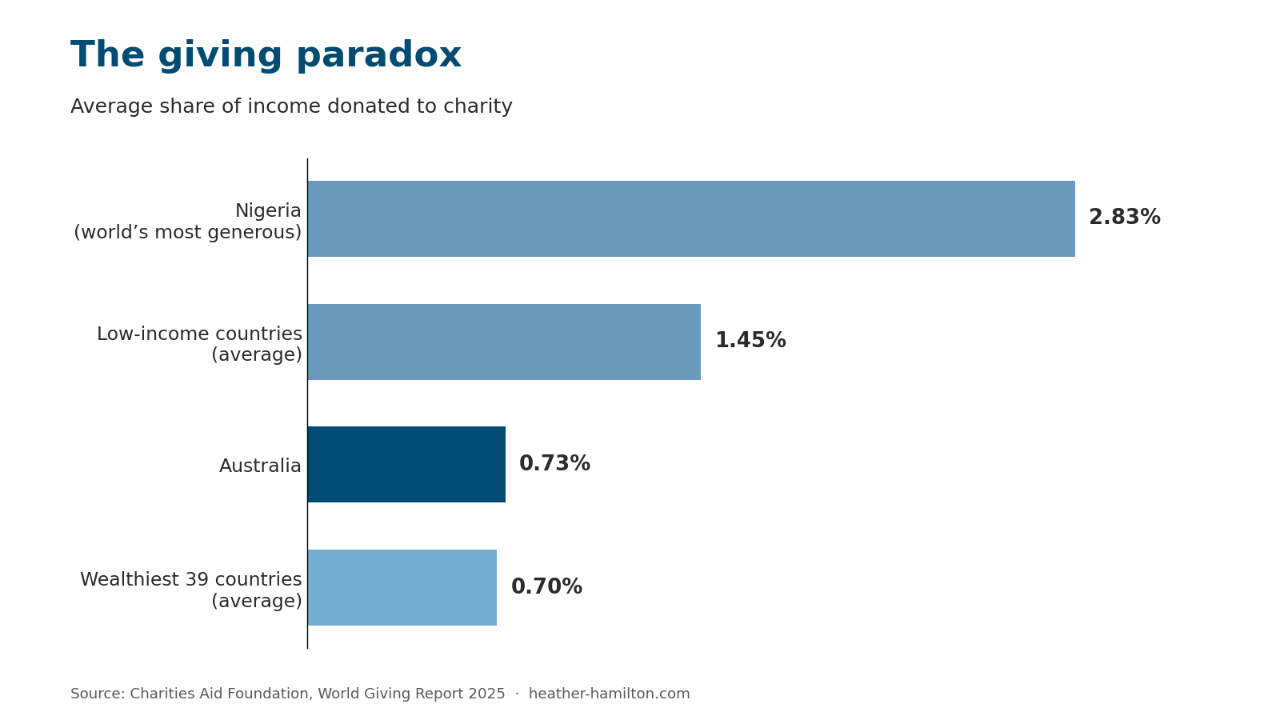
Three major reports on giving have landed in the past few weeks, from three different continents. Read separately, each tells a reassuring story. Read together, they describe a paradox that should concern every leader of a purpose-driven organisation, in Australia and well beyond it.
The Charities Aid Foundation's World Giving Report 2026, drawing on 60,000 donors across 105 countries, found that generosity is widespread: roughly six in ten people worldwide donated money last year. Giving USA 2026 reported that American charitable giving passed US$600 billion for the first time, reaching a record $617.2 billion. And here at home, the ACNC's 12th Australian Charities Report showed sector revenue at a record $239 billion, growing at 7.5% while the broader economy managed 1.4%.
Performance records everywhere. So why does it feel harder than ever on the ground?
Because underneath every one of those headlines sits the same uncomfortable pattern: giving is growing in dollars while shrinking in breadth. And nowhere is that pattern more pronounced, or more solvable, than in wealthy countries like Australia.
The paradox in numbers
Start with the global picture. The CAF research confirms what its predecessor found last year: the world's most generous societies are not its wealthiest. Nigeria and Ghana sit at the top of the generosity table. Across Africa and Asia, people give a substantially larger share of their income than people in high-income countries, despite having far less of it. Last year's edition put the average share of income donated across the richest countries at just 0.70%, roughly half what people in low-income countries give. Australia, for all its prosperity, sat below the middle of the global table.
The domestic data sharpens the point. Philanthropy Australia has estimated total giving in Australia at around 0.8% of GDP, compared with roughly 1.8% in New Zealand and 2.1% in the United States. We are one of the wealthiest nations per capita on Earth, with one of the most sophisticated charitable sectors, and we give a smaller slice of our income than countries with a fraction of our capacity. The Productivity Commission's goal of doubling giving by 2030 exists precisely because of this gap.
As CAF's chief executive Neil Heslop observed of the global findings, "giving does not necessarily correlate with wealth or even security." Generosity, it turns out, is not a function of what people have. It is a function of what societies, and organisations, do with the impulse to give.
What the American record is hiding
If Australia shows the paradox of capacity, the United States shows the paradox of concentration, and it is a preview worth studying closely.
Yes, US giving hit $617.2 billion. But look at what carried it there. Bequest giving surged nearly 20% to $62 billion, the strongest growth of any source, and accounted for roughly a third of the year's entire increase despite being only a tenth of the total. Individual giving grew a modest 1.4% in real terms. More telling still: individuals now provide 64% of American giving, down from around 80% in the mid-1980s, and individual giving as a share of disposable income has fallen to 1.7%, well below its historical peaks.
Meanwhile, the Fundraising Effectiveness Project's data shows the gains concentrating in larger gifts while the number of smaller donors stagnates or declines, and organisations continue to struggle to retain first-time givers.
Translate that from statistics into strategy and the message is stark: the record was set by fewer, older, wealthier donors giving bigger amounts, increasingly through structured vehicles and estates. That is not a broad culture of generosity strengthening. That is generosity narrowing at the base while the peak grows taller. Every organisation whose funding rests on that narrowing base is accumulating risk, however good this year's numbers look.
The Australian mirror
Australia's sector data reflects the same shape. The ACNC's record revenue headline sits alongside quieter findings: expenses grew faster than revenue in the latest reporting period, volunteer numbers continue their long decline, and the sector's smallest charities, which make up the majority of registered organisations, attracted just 8.6% of all donations and bequests while generating 1.4% of sector revenue. The money is pooling at the top of the sector, exactly as it is pooling at the top of the donor pyramid.
Donor behaviour research tells the same story from the other side. ntegrity's ongoing surveys of Australian donors show intent to give recovering strongly as cost-of-living pressure eases, with a striking wrinkle: a large share of those intending to give had been out of the giving habit for two or three years. The willingness survived the downturn. The habit did not. And Australia's major gift market has boomed, with major donor income growing around 60% over five years, even as the broader donor base thinned.
Concentration is comfortable right up until it isn't. Ask any organisation that has lost one significant funder.
Why wealthy countries under-give
Here is where the CAF research earns its keep, because it does not stop at describing the gap. It explains it, and the explanation should reframe how every board and executive team thinks about fundraising.
The single strongest driver of generosity in the global data is not income. It is social expectation. People who feel a strong norm to give donate roughly twice as much as those who do not. Those norms are powerful across Africa and Asia, where giving is visible, discussed, and woven into community life. In Australia, giving is institutional and intensely private: we donate through organisations rather than within communities, we rarely talk about it, and so the reinforcing loop that makes generosity contagious never quite closes.
Wealth itself plays tricks on us. People in high-income countries are more likely to say they cannot afford to give, and more likely to distrust charities, than people with objectively far less. Affordability and trust, in other words, are perceptions, not facts. And trust is decisive: people with high trust in charities are four times more likely to donate.
Add one final, humbling finding from the American research: among the most common reasons people give for not donating is simply that nobody asked them.
Not asked. Not trusted. Not talked about. None of these is a deficiency of donors. Every one of them is something organisations and their leaders can influence.
The half of the paradox we control
This is the conclusion I keep arriving at after three decades working across education and the broader for-purpose sector in Australia and Asia-Pacific: we have spent years diagnosing our funding challenges as a generosity problem, when the evidence keeps insisting it is a capability problem.
The generosity is demonstrably there. Australians turn out in floods and fires. Donors return the moment financial pressure lifts. The wealth transfer now underway, estimated at $3.5 trillion in Australia and over US$100 trillion globally in the coming decades, represents the largest movement of private capital in history, and the American bequest surge suggests it has already begun arriving.
What is scarce is not willingness. It is the organisational machinery that converts willingness into sustained support: the compelling case that makes a gift feel necessary rather than nice, the leadership and board who visibly give and ask, the systems that know who your supporters are and steward them faithfully, the partnerships that extend reach beyond your own list, and the evidence of impact that earns the trust the data says quadruples giving.
In my experience, most purpose-driven organisations know their why. Far fewer have built the how. And the giving data suggests the cost of that gap is measured not in one weak appeal, but in a national culture where generosity remains private, unasked, and underdeveloped.
There is a regional dimension worth naming, too. The same research that shows Asia's stronger giving norms also shows Asian respondents crediting their governments and institutions with actively encouraging generosity. As Asia-Pacific wealth grows and its philanthropic infrastructure matures, the countries of this region may have more to teach Australia about building a culture of giving than the traditional Anglo-American models we habitually copy.
What leaders should do with this
If you lead a purpose-driven organisation, this year's reports suggest five priorities.
- Audit your concentration risk honestly. If the majority of your philanthropic income comes from a handful of sources, this year's records are not reassurance; they are a countdown.
- Rebuild breadth deliberately. Lapsed donors are not lost donors; the Australian data shows they are waiting to be re-invited. Ask more people, more personally, more often than feels comfortable.
- Treat trust as your primary fundraising asset. Impact evidence, transparent reporting, and credible governance are not compliance overheads. On the data, they are worth a fourfold difference in the likelihood of a gift.
- Take the wealth transfer seriously now. Bequests did the heavy lifting in the American record. Organisations without a genuine planned-giving conversation are absent from the largest funding shift of our lifetimes.
- Most importantly, make giving visible and discussed, starting with your own board and leadership. Cultures of generosity are built where giving is normal, expected, and talked about. If it is not normal at your board table, it will not be normal anywhere else in your organisation.
Australia does not have a generosity deficit. It has a systems deficit, and systems can be built. That, at least, is a paradox with a solution.
Heather Hamilton is the founder of Advfinity and works with purpose-driven organisations and their leaders across Asia-Pacific. She is currently researching purpose clarity across the sector.